One of my favorite stories— which I have told way too many times– is about the time my husband, Bernie, and I were white water rafting down the Nantahala River in the mountains of North Carolina.
They drove us up the mountain in an old, yellow, repurposed school bus. But, before that, they gave us an orientation to the river.
In the orientation they warned that toward the end of the river there were deadly waterfalls called Wesser falls. They warned that it had not ended well for those who went over those falls.
Soon we were on our way, navigating our boat down the rapids. It had rained the entire week before, so the river was fast, powerful and exhilarating.
That is, until we failed to maneuver a six-foot drop in the river and were both thrown from the boat. There we were in freezing, fast rapids heading toward the deadly Wesser Falls. I noticed people running alongside the river with ropes. It was hard to hear their instructions over the roaring river, but I thought I heard one person scream, “Let the river carry you. We will drop ropes –2 miles downriver.”
Two miles seemed too far.
So I frantically tried to get myself out of that river—I kept trying to stand up and kept getting knocked over by the strong currents.
I managed to catch a glimpse of Bernie’s head bobbing in the white caps. He looked so peaceful; like he was actually enjoying the ride.
Eventually, when I was too exhausted to struggle any more, I leaned back and let the river carry me.
Ropes were dropped, as promised, from an overpass and we were pulled to safety.
An hour or so later as we were warming ourselves by a fire, I asked Bernie, “how did you manage to be such a Zen Master while heading toward deadly falls.” He responded, “I wasn’t paying attention during the orientation. I had no idea we were headed toward deadly falls.”
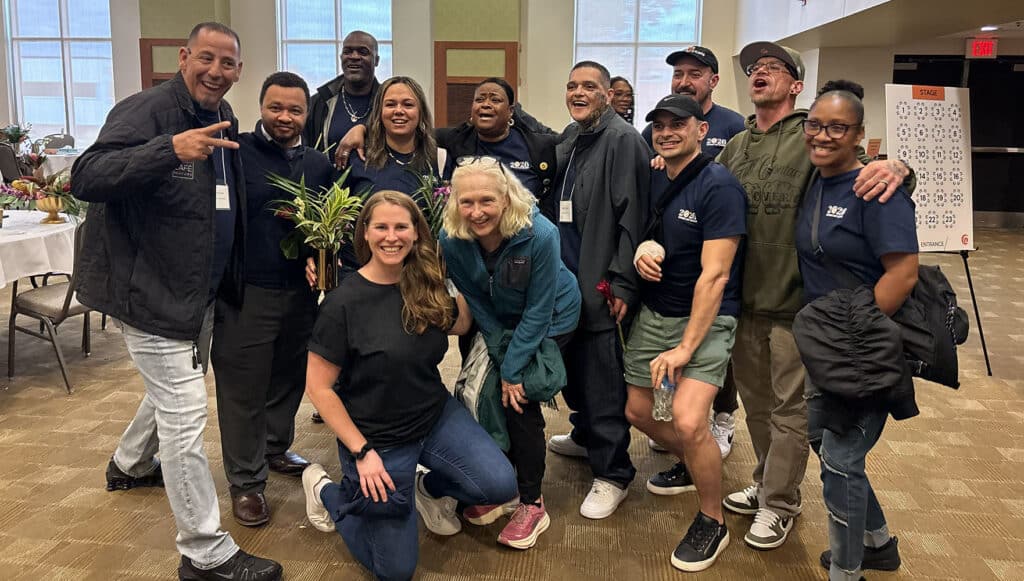
We have gathered from different towns and cities, from regions urban and rural, from the US and Canada.
Unless you’re here for the National Coin Collectors Conference– which I’m told is one floor up— we all share a common call to offer our lives as transmitters of love.
Whether our role is making soup in the kitchen, balancing the books in the office, or de-escalating a conflict on the Café floor, our deepest call is transmitting love.
But how do we lean back more fully into the powerful current of transforming love and let that current carry us? How do we trust that everything we need to live out our call will be given—that the ropes will be dropped just in time?
How do we become next level free so that we can transmit next level love?
Because we are living in a time of upheaval and our world desperately needs next level love.
I’d like to highlight six practices for transmitting next level love. These practices will not be new to any of you, but perhaps we can all take them in at a new level.
First practice: If we are to transmit next level love, we must continuously let our hearts break. 25 years ago, the call to create the first Recovery Café came from Ruby’s and my broken hearts over the suffering in our community. As you know so well, grace enters into and flows outward through, undefended, broken hearts. We are grateful for this ballroom full of broken hearts.
Second practice: If we are to transmit next level love, we must hold space for members, staff and volunteers to do next level identity unwinding and reclaiming of our true identity—which is love.
From the moment we are born our identity is being programmed by our family, our culture, our religion and our tribe. Even if we’ve been programmed in some positive ways, make no mistake, we’ve all been programmed. We all took in with our mother’s milk what behaviors would make us an insider or an outsider.
Some of us received the message, “You are not enough; you are not smart enough, accomplished enough or successful enough.” Others of us received the message, “You are too much; too loud, too opinionated, too outside the box.
Few of us in early life, even if we had supportive families, were fully seen, fully celebrated, just as we were.
So what needs to be unwound in all of us is the false identity that tells us we are not worthy of being fully seen, fully celebrated, just as we are.
We all long for our essence to be seen and celebrated. I am not talking about our “doing” self, the one who is always performing and proving. I am talking about our being, our truest self.
Unless our doing flows from our being, our truest self, which is love, it will have limited power to heal and transform. Does this ring true to you?
On top of that programming there is often the trauma associated with a one-time event or the repeated experiences of one trauma after another after another known as complex trauma. Many of us here and almost all of the people we welcome each day in our Recovery Cafes have experienced complex trauma.
So, everything we do—the warm welcome at the front door, the freshly painted walls, the delicious food, the multiple pathways we honor… it is all in service to unwinding identities formed by earlier programming, trauma and the results of trauma so that we can reclaim our true identity—which is love.
When we were preparing to open the doors of our first Recovery Café, Starbucks gave us a gorgeous espresso machine. One of our early board members questioned, “Where does espresso fit on Maslow’s hierarchy of needs?”
What she didn’t understand at the time is that handing our members a coffee drink made especially for them was one way of communicating, “you are seen, celebrated and loved beyond your wildest imagination. In fact, you are irreplaceable as a transmitter of love to others in our community.”
Some of you have heard me share the story of Tana. As a little girl she got spinal meningitis. The hospital bills were so devastating for her family that her father started calling her “little criminal.”
After decades of using in various ways to numb the pain of her complex trauma, she found Recovery Café. One day she came to me and asked me if I would go with her to return the court seal she had stolen from a Seattle judge’s courtroom.
Seated in the judge’s chamber Tana handed the leather case containing the court seal to the judge and she said:
“It is true that I stole this seal from your courtroom. And it is also true that I now know without a shadow of a doubt that I am loved and am an instrument of love in the lives of others.”
I noticed tears streaming down the judge’s face.
The bottom line is this; Knowing we are loved is important, but it is transmitting love that transforms us and others.
Because the most significant way to strengthen the light in ourselves is to call forth the light in others.
The third practice I want to highlight for transmitting next level love is this: We must give our all and at the very same time let go of all results.
When I was 24 years old and part of an ecumenical community in Washington DC, my mentor, Gordon Cosby, gave me the gift of a trip to India to work in Mother Teresa’s Home For the Dying. Mother Teresa was still alive at that time, so this trip was a rare opportunity to learn directly from her.
When I opened the card from Gordon and discovered a check for this trip to India, I resisted. “I said, “this gift is too much.”
Gordon didn’t try to convince me. He didn’t argue with me at all.
He simply said, “This is my gift to you. I don’t care if you choose to go to India or choose to throw this check into the Potomac River.”
I was a little shocked. I had never before received a gift given with such freedom—with no strings attached.
I did go to India and the experience is still with me.
The first day volunteering at the Home for the Dying, I carried a frail, dying woman to the bathing area to give her a bath. I was struck by the words written in English on the wall just above the bathing area. The words were, “This is the body of Christ.”
It was a reminder to us volunteers to see and celebrate the divine in every life we touch.
It was a reminder that whatever our understanding of divine love– be it unconditional love, higher power, true self, Ground of all Being, quantum physics –whatever our understanding —every life is sacred.
It confirmed for me the importance of what would later become one of Recovery Café’s guiding principles, “to connect with divine love in ourselves and others.”
Not long ago, I was walking into the grocery store when I noticed a woman who appeared to be experiencing homelessness. I asked her if I could bring her anything from the store. She requested a specific kind of juice called Immune, which contains a mixture of fruits and zinc. I gladly purchased it and handed it to her as I left the store. She said, “thank you, this is exactly what I wanted.”
The next time I went to that same store I saw that same woman. I am embarrassed to say, without asking her, I decided to purchase for her the same juice. Leaving the store, I sat the gallon jug of juice next to her mat. As I walked away, she threw the heavy jug of juice at my back.
It reminded me that our call is to keep showing up with lovingkindness—knowing we won’t always get it right—and to keep letting go of results.
This practice of giving our all and letting go of all results is what we hope to bring to our resource raising efforts, and to all our relationships.
This is not easy. We all need a small group of others running alongside us as we head toward our own version of Wesser Falls.
When we practice radical acceptance we are more open to radical assistance, but well unpack that more later.
Which brings me to a fourth practice of next-level love. We all need a daily practice that helps us release fear and trust abundance.
The daily practice that I have found to be one of the most helpful practices of my life is following my feelings back to their source. Following our feelings back to their source eventually leads us to the heart of love in us, our true home. We are programmed to rely on our minds instead of allowing our feelings to be our GPS, directing us to our hearts.
We humans tend to do three things with our feelings. We stuff them. We project them, that is, we blame others for them. And we numb them.
What if, instead of stuffing, blaming or numbing our feelings, we had a daily or hourly practice of welcoming our feelings, of wondering what they are telling us, of unwinding them to their source and then when we are ready releasing them? This is a process requiring awareness, awareness, awareness.
Including and then releasing feelings—like shame, jealousy, anger and fear—creates space in us for abundant love and joy, which is our birthright.
The great sufi poet Rumi compared welcoming our feelings to welcoming guests to a guest house. He wrote:
“Be grateful for whoever comes because each has been sent as a guide from beyond.”
Welcoming and releasing all of our feelings as they come makes possible our responding to reality from a spacious, creative place.
And it is from a spacious, creative place —not from shame or fear— that the most impactful responses to injustice are given.
In 2003, Leymah Gbowee, inspired by a dream, not a spread sheet, led a nonviolent movement of Muslim and Christian women that helped end Liberia’s 14- year civil war.
At a crucial moment when the peace talks seemed stalled, Leymah and nearly 200 women formed a human barricade to prevent the government representatives and the rebel warlords from leaving the meeting hall.
When security forces attempted to arrest Leymah, she threatened to disrobe – an act, that according to traditional beliefs, would have brought a curse upon the men. Her tactical threat proved to be a decisive turning point for the peace process. Within weeks, a peace treaty was signed and in 2011 she was awarded the Nobel Peace Prize.
The fifth practice is another paradox. If we want to transmit next level love, we cannot demonize others.
But how do we let our hearts break over the suffering in our communities without demonizing those we deem responsible for the suffering?
Let’s be clear, I am not suggesting we refrain from speaking truth to power or that we shy away from naming the evils and injustices we see. I am saying that when we demonize others —when we are unable to see all others as human beings in need of love and forgiveness, just like us– we run the risk of becoming the very thing we deplore.
Martin Luther King Jr. boldly named the evils of racism, poverty and war. But he never lost sight of the humanity of his oppressors. He recognized that those consumed by hatred are the most oppressed of all.
He understood that the most powerful response to injustice is to expose the contempt that drives it and to respond to contempt with dignity.
I am blown away by the courage of Dr. Daryl Davis, a black man who currently lives in Virginia. He sought out real relationships with KKK members resulting in hundreds of them renouncing their hate-filled ideology. He told them, Before you can hate me, you have to know me.” Real relationships are what change us and ultimately change our world.
As you know, the Bhagavad Gita is an ancient text that has been inspiring people of different faiths for over 5,000 years.
In this narrative Arjuna is standing on the battlefield preparing to lead his army into battle against their enemies. When Arjuna looks across the battlefield, he sees his own father, and his own cousins and other family members are on the other side, He is faced with the truth that the enemy is also his family.
How do we live so deeply grounded in love that we recognize that the enemy across the battlefield is actually our own father, our own cousins, our own human family?
Two suggestions.
We must commit to a path of ever deepening self-awareness. As we become increasingly aware of both the darkness and light in ourselves, we become increasingly aware of our shared humanity with those we once preferred to simply demonize for their darkness.
Secondly, we must recognize that loving our enemies is not pie in the sky idealism. It may be the most practical instruction ever given.
What if our Cafes were not just drug and alcohol -free oases, but contempt-free zones? What if our Cafes were lighthouses, free of any demonizing, shining the light of dignity far and wide?
Which brings me to the final practice I want to highlight.
If we are to be next level free and transmit next-level love, we must forgive everyone and everything.
Forgiveness liberates us from contempt and demonizing.
One of the leaders of Recovery Café Skagit, Valerie, embodies this truth. Several months ago, her nephew was shot and killed by another young man. At the bail-reduction hearing the perpetrator not only showed no remorse toward the grieving family members who were present, he made hateful, hurtful, hand gestures to them.
Valerie shared, “I knew if I held onto the bitterness and hate I was feeling at that hearing, it would destroy me.”
This highlights what we all know so well; forgiving everyone– including ourselves– is our path to freedom.
That’s why “practicing forgiveness” is one of our guiding principles.
And of course, forgiving ourselves and others is ultimately beyond us and can only be given through us.
Sometime last year I told a Leader support circle, “I’ve finally forgiven an abusive person in my life for everything they did. I think I have finally reached the basement of forgiveness.”
One of the wise participants in the circle responded, “When you get to the basement of forgiveness, sometimes you’ll discover there is another elevator waiting to take you to parking level 1 and parking level 2.”
Is there someone you need to forgive? Today would not be too soon.
For the past half hour, we’ve been reflecting on practices that help us embody and transmit next level love.
Embodying and transmitting next level love is our non-violent resistance to the powers that oppress, exclude, terrorize and demonize members of our human family.
Embodying and transmitting next level love is our most effective response to the upheaval in our world.
One early morning before our Seattle Café opened, David Coffey, our ED of Seattle Cafes, saw one of our members with her hands pressed against the exterior brick wall of our Cafe; like she was warming her hands by a fire. When David asked her if she was OK, she responded, “I am just connecting with the love that radiates from this place.”
Our Cafes are brilliant bonfires— radiating love that lights up the darkness of our time. Our Cafes show the world what it looks like when a small group of people from different races, religions, socioeconomic realities and political persuasions live like we belong to each other. Our Cafes are our delivery system for setting the world on fire with love.
Most of us have been programmed by a dualistic culture; a culture that judges everything and everyone as good or bad, right or wrong. For years I struggled to get everything right—even in yoga.
One day I heard a young yoga teacher say, ”the most powerful pose in yoga is the pose of lying flat on your back; proving absolutely nothing, judging absolutely nothing.”
It is not a passive pose.
It is a pose of surrender. It is a pose of next level allowing.
So, I end my remarks where I began.
Are we ready to lean back into love’s powerful current and allow that love to carry us to people and places we’ve never even dreamed of going before?
Maybe carrying us into prisons in a more systematic way?
Or into partnerships with entire denominations of churches, mosques and synagogues?
Or into innovative partnerships with health-care systems and for-profit organizations?
Are we ready to allow the love-force of the universe to change the world through us?
Anthropologist Margaret Meade reminds us: “Never doubt that a small group of committed people (like you and me) can change the world. It is the only thing that ever has.”
But we will not change the world with toxic energy and sour-puss faces. We must do everything we do with wildly, contagious joy. The Sufi poet Hafez wrote:
“I sometimes forget that I was created for joy. My mind is too busy. My heart is too heavy. I was created to be lifted up and to lift up others. Oh sacred one, free our souls that we might dance and that our dancing might be contagious.”
I am in awe of every single one of you.
K.Killian Noe
Founding Director – Recovery Café